a look at Robert J. Sawyer’s #SciFi Collection @RobertJSawyer @SDSXXTours

Golden Fleece
by Robert J. Sawyer
Genre: SciFi Mystery
Winner of the Aurora Award for best novel of the year. Named best novel of the year by The Magazine of Fantasy & Science Fiction.
MURDER IN SPACE
Starcology Argo. A superstarship on a mission to a distant world. Controlled by a monumental computer named JASON, the Argo proceeds flawlessly . . . until death strikes its sleek decks with sudden and mysterious precision.
Astrophysicist Diana Chandler is dead of radiation. Her body lies in the Argo’s ramfield — where hydrogen ions are funneled into the engines. Chandler’s death has been deemed suicide. But her ex-husband, Aaron Rossman, isn’t so sure. As he probes further, he becomes certain that Diana’s death is a matter of murder — and that the murderer is JASON!
Now Rossman must face the unthinkable: why would an artificial intelligence conceive and execute that most heinous of human crimes? And if so, can a mortal mind take on a cunning computer . . . and survive?
End of an Era
by Robert J. Sawyer
Genre: SciFi Fantasy
Paleontologist Brandon Thackeray is eager to find out what killed the dinosaurs. With a newly developed, still-experimental timeship, he will be able to do what no human being has ever done: stand face-to-face with a living, breathing dinosaur. But he and his partner (and rival) Miles “Klicks” Jordan discover that they are not the only intelligent creatures on Earth at the end of the Cretaceous. There’s a war going on and the dinosaurs are right in the middle of it.
Please note that this book is not part of The Quintaglio Ascension Trilogy. It is a stand-alone novel set on Earth.
Starplex
by Robert J. Sawyer
Genre: SciFi Adventure
The only novel of its year to be nominated for both the Hugo and Nebula Awards. Starplex won Canada’s Aurora Award for best novel of the year.
For nearly twenty years Earth’s space exploration had exploded outward, thanks to a series of mysterious, artificial wormholes. No one knows who created these interstellar passages, yet they have brought the far reaches of space immediately close. For Starplex Director Keith Lansing, too close.
Discovery is superseding understanding. And when an unknown vessel — with no windows, no seams, and no visible means of propulsion — arrives through a new wormhole, an already battle-scarred Starplex could be the starting point of a new interstellar war . . .
Frameshift
by Robert J. Sawyer
Genre: SciFi Thriller
Frameshift won Japan’s Seiun Award and was a finalist for the Hugo Award.
Pierre Tardivel is a scientist working on the Human Genome Project with the Nobel Prize winner, Dr. Burian Klimus. A driven man, Pierre works with the awareness that he may not have long to live: he has a fifty-fifty chance of dying from Huntington’s disease, an incurable hereditary disorder of the central nervous system. While he still has his health, Pierre and his wife decide to have a child, and they search for a sperm donor. When Pierre informs Dr. Klimus of their plan, Klimus makes an odd but generous offer: to be the sperm donor as well as to pay for the expensive in vitro fertilization. Shortly thereafter it transpires that Klimus might be hiding a grim past: he may be Ivan Marchenko, the notorious Treblinka death-camp guard known as Ivan the Terrible.
While digging into Klimus’s past with the help of Nazi hunter Avi Meyer, Pierre and his wife discover that Pierre’s insurance company has been illegally screening clients for genetic defects. The two lines of investigation begin to coverage in a sinister manner, while they worry about the possibility of bearing the child of an evil, sadistic killer . . .
Factoring Humanity
by Robert J. Sawyer
Genre: SciFi
In 2007, a signal is detected coming from the Alpha Centauri system. Mysterious, unintelligible data streams in for ten years. Heather Davis a professor in the University of Toronto psychology department, has devoted her career to deciphering the message. Her estranged husband, Kyle, is working on the development of artificial intelligence systems and new computer technology utilizing quantum effects to produce a near-infinite number of calculations simultaneously.
When Heather achieves a breakthrough, the message reveals a startling new technology that rips the barriers of space and time, holding the promise of a new stage of human evolution. In concert with Kyle’s discoveries of the nature of consciousness, the key to limitless exploration — or the end of the human race — appears close at hand.
This edition includes a reading group guide.
Robert J. Sawyer — called “the dean of Canadian science fiction” by The Ottawa Citizen and “just about the best science-fiction writer out there these days” by The Denver Rocky Mountain News — is one of only eight writers in history (and the only Canadian) to win all three of the science-fiction field’s top honors for best novel of the year: the World Science Fiction Society’s Hugo Award, which he won in 2003 for his novel Hominids; the Science Fiction and Fantasy Writers of America’s Nebula Award, which he won in 1996 for his novel The Terminal Experiment; and the John W. Campbell Memorial Award, which he won in 2006 for his novel Mindscan.
According to the US trade journal Locus, Rob is the #1 all-time worldwide leader in number of award wins as a science fiction or fantasy novelist. Recent honors include the first-ever Humanism in the Arts Award from Humanist Canada, the Queen Elizabeth II Diamond Jubilee Medal from the Governor General of Canada, the Hal Clement Award for Best Young Adult Novel of the Year (for Watch), and a Lifetime Achievement Aurora Award from the Canadian Science Fiction and Fantasy Association — the first such award given to an author in thirty years, and only the fourth such ever bestowed,
The 2009-2010 ABC TV series FlashForward was based on his novel of the same name, and Rob was a scriptwriter for that series. Maclean’s: Canada’s Weekly Newsmagazine says, “By any reckoning, Sawyer is among the most successful Canadian authors ever,” and The New York Times calls him “a writer of boundless confidence and bold scientific extrapolation.” The Canadian publishing trade journal Quill & Quire named Rob one of “the thirty most influential, innovative, and just plain powerful people in Canadian publishing” (the only other authors making the list were Margaret Atwood and Douglas Coupland).
Rob’s novels are top-ten national mainstream bestsellers in Canada, appearing on the Globe and Mail and Maclean’s bestsellers’ lists, and they’ve hit #1 on the science-fiction bestsellers’ lists published by Locus, Amazon.com, Amazon.ca, Amazon.co.uk, and Audible.com. His twenty-three novels include Red Planet Blues, Triggers, Calculating God, and the “WWW” trilogy of Wake, Watch, and Wonder, each volume of which separately won the Aurora Award — Canada’s top honor in science fiction — for Best Novel of the Year.
Rob — who holds honorary doctorates from the University of Winnipeg and Laurentian University — has taught writing at the University of Toronto, Ryerson University, Humber College, and The Banff Centre. He has been Writer-in-Residence at the Richmond Hill (Ontario) Public Library, the Kitchener (Ontario) Public Library, the Toronto Public Library’s Merril Collection of Science Fiction, Speculation and Fantasy, Berton House in Dawson City, the Canadian Light Source synchrotron, and the Odyssey Workshop.
Rob has given talks at hundreds of venues including the Library of Congress and the National Library of Canada, and been keynote speaker at dozens of events in places as diverse as Los Angeles, Boston, Tokyo, Beijing, and Barcelona. He was born in Ottawa in 1960, and now lives just west of Toronto.
Follow the tour HERE for exclusive excerpts, guest posts and a giveaway!

a look at ‘Welcome to the Apocalypse by D L Richardson’ #Apocalyptic #SciFi @DLRichardson1 @SDSXXTours

Welcome to the Apocalypse
Book 1- Pandora
by D L Richardson
Genre: Apocalyptic Sci-Fi
The Apocalypse Games is a state of the art virtual game designed to entertain doomsday preppers, gamers, and cosplayers. But not everyone who enters is there to play the game the way the creators intended. Some players don’t belong at all and some enter the game to escape reality.
Whatever the reason, over 100 people hook up to the mainframe computer with one goal: survive twenty-four hours of an apocalypse. Instead of game over at the end, they’re plugged straight into a new game. Then another. It’s clear to the players the computer has malfunctioned. What isn’t clear is why.
Welcome to the Apocalypse
Book 2- CyberNexis
Getting out of the game used to be all that mattered. Now all that matters is getting back in.
THEN…
The Apocalypse Games is a state of the art virtual game designed to entertain doomsday preppers, gamers, and cosplayers. But not everyone who entered was there to play the game the way the creators intended. Some players didn’t belong at all and some entered the game to escape reality. Whatever the reason, over 100 people were hooked up to the mainframe computer with one goal: survive twenty-four hours of an apocalypse. Instead of game over at the end, they were plugged straight into a new game. Then another. It was clear to the players the computer has malfunctioned. What wasn’t clear was why.
NOW…
the players find themselves in an offsite facility far from their original location, unsure why or how CyberNexis moved them. Getting out of the game used to be all that mattered. But not anymore. The world has changed and CyberNexis is keeping a secret that needs to be exposed.
D L Richardson likes many things. Reality isn’t one of them. D L Richardson is the creator of ‘Welcome to the Apocalypse’ series as well as the author of YA fantasy and horror novellas which can be likened to ‘Goosebumps for adults’.
The author’s world is her dog, her husband, coffee, and her writing. Not always in that order. You won’t find the usual tropes in D L Richardson’s books. You will find unique stories, engaging characters, and thought-provoking situations.
Follow the tour HERE for exclusive excerpts, guest posts and a giveaway!

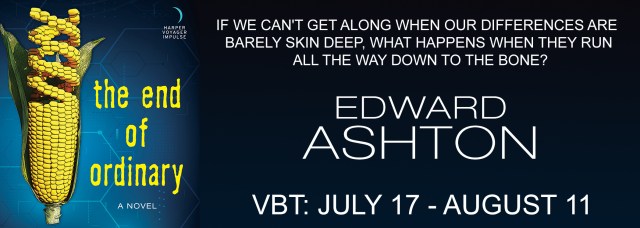
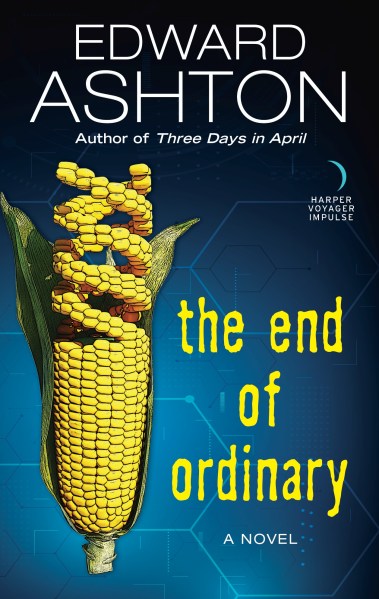
Welcome to Edward Ashton w/ #SciFi #book ‘The End of Ordinary’ @edashtonwriting @GoddessFish

Today we have author Edward Ashton visiting. Welcome!

What would you like to tell readers about yourself?

* Edward Ashton lives with his adorably mopey dog, his inordinately patient wife, and a steadily diminishing number of daughters in Rochester, New York, where he studies new cancer therapies by day, and writes about the awful things his research may lead to by night. He is the author of Three Days in April, as well as several dozen short stories which have appeared in venues ranging from the newsletter of an Italian sausage company to Louisiana Literature and Escape Pod.

Today Edward Ashton will be talking about Advice to the Writer: Don’t Quit Your Day Job

* One sunny afternoon in April of my junior year in college, my favorite professor called me into her office. She was a poet of some note, and had spent the past two semesters trying to cram the concepts of rhyme, rhythm and meter into my prose-centric skull. I thought she might be planning on tearing apart my latest sad effort at blank verse, but no. She was in a mellow mood. She invited me to sit.
* “So,” she said. “How are you progressing these days?”
* “Um,” I said. “What?”
* She rolled her eyes.
* “Your academics, Ed. How are you progressing? You’ve been working toward a double major, no?”
* I nodded. I’d been keeping one foot in writing and the other in engineering for the past three years. This wasn’t an easy balance. There were surprisingly few classes that fulfilled requirements for both degrees.
* “Good,” she said. “That’s very good. You know my next book is coming out soon?”
* I nodded again. She’d been pretty clear on that point. She leaned back in her chair, and looked up at the ceiling.
* “I just got my advance check,” she said. “Do you know what I did with it?”
* I shook my head.
* “I bought an air conditioner.”
* I opened my mouth to say something positive, but she went on before I could.
* “Not a central air unit, Ed. The kind that goes in your window.” She sighed. “Study hard in your engineering classes. You don’t look like the sort who can live on bologna.”
* As a writer—or as any kind of artist, really—there’s always a delicate balance to be struck between following your dreams, and making some kind of reasonable accommodation with the world. The economics are pretty similar for almost anyone whose primary job is to entertain. A very small number of people make obscene amounts of money (Taylor Swift, or Lebron James, or J.K. Rowling) while a great many people work extremely hard for something close to nothing (your local bar band, or some anonymous power forward playing for the Rapid City Twisters, or my poet-mentor.) Writing a novel is much more akin to buying a lottery ticket than it is to landing a plum job at Google.
* This is not to say, of course, that you should set aside your dreams of artistic glory, and resign yourself life as an office drone. However, if you run down a list of famous speculative fiction writers, you’ll find an awful lot of folks who didn’t quit their day jobs. Isaac Asimov was a tenured professor, as is David Brin. Robert L. Forward was an aerospace engineer. John Scalzi… well John Scalzi got a multimillion dollar book deal with Tor. If you manage to pull that off, yes, you can resign your position at GloboMax Corp post-haste.
* As for me? I’m still keeping one foot in both worlds. I’ve published dozens of short stories over the last couple of decades, as well as two novels (Three Days in April and The End of Ordinary, both from HarperCollins) with a third on the way. I’ve also built a career as a cancer researcher, and published a thick stack of journal papers and medical texts along the way. Time management is an issue at times (take a look at my previous post on writing in the interstices for more on that) but I don’t actually feel like my scientific career detracts from my writing. To the contrary, some of my best plot twists have come from things I learned during the course of my research. There might not be quite as much synergy if my day job were in accounts receivable at Target, but I’m sure I could find something to work with even there.
* The important thing to remember at the end of the day is that to be a writer, you don’t have to be only a writer. You just have to write. Also, it’s tough to live on bologna cooked over a garbage fire. Can’t forget about that.

A look into…

~ Blurb ~

* Drew Bergen is an Engineer. He builds living things, one gene at a time. He’s also kind of a doofus. Six years after the Stupid War — a bloody, inconclusive clash between the Engineered and the UnAltered — that’s a dangerous combination. Hannah is Drew’s greatest project, modified in utero to be just a bit better at running than most humans. She’s also his daughter. Her plan for high school is simple: lay low and run fast. Unfortunately for Hannah, her cross-country team has other plans.
* Jordan is just an ordinary Homo-Sap. But don’t let that fool you — he’s also one of the richest kids at Briarwood, and even though there isn’t a single part of him that’s been engineered, someone has it out for him.
* Drew thinks he’s working to develop a spiffy new strain of corn, but Hannah and her classmates disagree. They think he’s cooking up the end of the world. When one of Drew’s team members disappears, he begins to suspect that they might be right. Soon they’re all in far over their heads, with corporate goons and government operatives hunting them, and millions of lives in the balance.

~ Excerpt ~

* “Okay,” he said. “Let’s take this one step at a time. Why do you need accomplices?”
* “I already told you,” Micah said. “We are like ninety percent fully opposed to your plans to murder Jordan. Ninety-five percent, even.”
* “Quiet,” Bob said. “Grownups are talking now.”
* “Micah’s an idiot,” Marta said, “but believe it or not, he’s mostly right. We know about Project Snitch, Daddy.”
* Bob’s eyebrows came together at the bridge of his nose.
* “Project what?”
* Marta rolled her eyes.
* “Give it up, Dad. I don’t have anything else to do around here, so I snoop. I’ve heard you and Marco talking about Project Snitch more than once.”
* “Actually,” I said, “I think Hannah said that the real name for it was Project Dragon-Corn.”
* Bob’s face went blank.
* “Oh,” he said, after a long, silent pause. “Oh. Oh, honey. You mean project Sneetch.”
* I looked at Marta. Marta looked at me. Micah finished his smoothie, wiped his mouth with the back of his hand, and smiled.
* “Uh,” Marta said. “What?”
* Bob sighed.
* “Sneetch, honey. Not Snitch. Sneetch.”
* “Oh,” Marta said. “I thought you were just making fun of Marco’s accent when you said it that way.”
* We all turned to stare at her.
* “Anyway,” I said. “Confusion-wise, I’m not sure that’s…”
* I slapped my palm to my forehead and let out a long, low groan.
* “What?” Micah asked. “Are you having a stroke?”
* “Sneetch,” I said. “Project Sneetch. Holy shit, dude. You think you’re Sylvester McMonkey McBean.”
* “Right,” Bob said. He leaned back, and crossed his arms over his chest. “See, honey? Your gay boyfriend gets me.”

Buy The End of Ordinary here…
Amazon

Find Edward Ashton here…
Amazon Author Page | Facebook | Goodreads | Twitter | Website

Thank you for joining us here today, Edward Ashton! It was a pleasure getting to know you and your story.

ANNOUNCEMENT! Edward Ashton will be awarding a 14 Ounce Nalgene—filled with candy corn! & 1 VeryFit Smart Band (US only) to a randomly drawn winner via rafflecopter during the tour! So be sure to leave a comment AND use this RAFFLECOPTER LINK to enter the drawing. Also, visit the other tour stops for a greater chance of winning!